Moz Q&A is closed.
After more than 13 years, and tens of thousands of questions, Moz Q&A closed on 12th December 2024. Whilst we’re not completely removing the content - many posts will still be possible to view - we have locked both new posts and new replies. More details here.
Screaming From occurences and canonicals what does it all mean
-
Bonjourno from Wetherby UK...
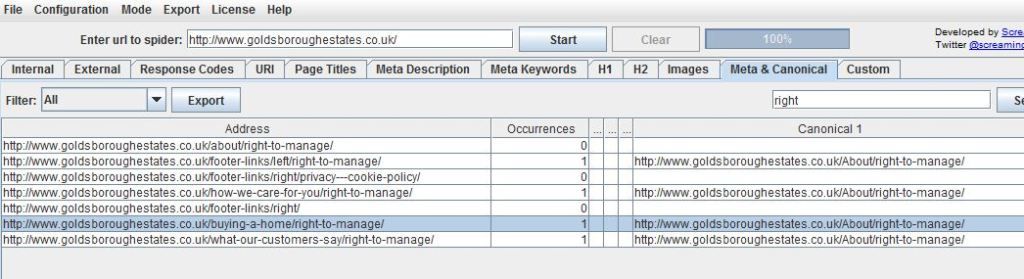
Ive used a package called screamong frog to diagnose canonical errors but can anyone tell me what this means? http://i216.photobucket.com/albums/cc53/zymurgy_bucket/understand-occurances-canonical.jpg
Thanks in advance.
David
-
Thank you for all your replies this was bugging me but the pain of not knowing has vanished like the morning mist as the warming glow of sunshine illumunates truth

-
David
Looks like you may have an issue there. The "address" and "canonical 1" should match about 99% of the time. Right now you're telling Google to index all those different address pages as a single URL (About/right-to-manage)... something to look at - and the suggestions below are both good as well.
-Dan
-
I agree with what Streamline Metrics said, I just want to add to this by linking you to a great SEOmoz post on canonicalization which may help you clear things up more.
In your case, having 1 rel="canonical" tag per page is what you want, so you should be fine with that, just make sure that the canonical tags (listed under canonical 1 in Screaming Frog) is the actual URL that you want.
Hope this helps
Zach -
It simply means how many canonical tags are found on that specific page. So if you had two rel=canonical tags on a page, it would say 2 occurrences. For more info, check out http://www.screamingfrog.co.uk/seo-spider/user-guide/tabs/





Browse Questions
Explore more categories
-
Moz Tools
Chat with the community about the Moz tools.
-
SEO Tactics
Discuss the SEO process with fellow marketers
-
Community
Discuss industry events, jobs, and news!
-
Digital Marketing
Chat about tactics outside of SEO
-
Research & Trends
Dive into research and trends in the search industry.
-
Support
Connect on product support and feature requests.
Related Questions
-

Canonical or hreflang?
I have four English sites for four different countries, UK, Ireland, Australia and New Zealand and I want to share some content between the sites. On the pages that share the content, which is essentially exactly the same on all 4 sites, do I use the hreflang tags like: or do I add a canonical tag to the other three pointing to the "origin", which would be the UK site? I believe it is best practice to use one or the other, but I'm not sure which make sense in this situation.
Technical SEO | | andrew-mso0 -

Duplicate, submitted URL not selected as canonical
Hi all, A number of our pages have dropped out of search rankings. It seems they are being marked as "Duplicate, submitted URL not selected as canonical" However, the page Google is choosing as the canonical is totally different - different headings, titles, metadata, content on the page. We are completely mystified as to why this is happening. If anyone can shed any light, it would be hugely appreciated! Example URL is this one:
Technical SEO | | Eric_S
https://www.vouchedfor.co.uk/IFA-financial-advisor-mortgage/london Which Google seems to think is a duplicate of this: https://www.vouchedfor.co.uk/solicitor/london0 -

What could cause Google to not honor canonical URLs?
I have a strange situation on a website, when I do a Google query of site:example.com all the top indexed results appear to be queries that users can perform on the website. So any random term the user searches for on the website for some reason is causing the search result page to get indexed - like example.com/search/query/random-keywords However, the search results page has a canonical tag on it that points to example.com/search, but that doesn't seem to be doing anything. Any thoughts or ideas why this could be happening?
Technical SEO | | IrvCo_Interactive0 -

Canonical for duplicate pages in ecommerce site and the product out of stock
I’m an SEO for an ecommerce site that sells shoes I have duplicate pages for different colors of the same product (unique URL for each color), Conventionally I have added canonical tags for each page, which direct to a specific product URL My question is what happens when a product which the googlbot is direct to, is out of stock but is still listed in the canonical tag ?
Technical SEO | | shoesonline0 -

Product Variations (rel=canonical or 301) & Duplicate Product Descriptions
Hi All, Hoping for a bit of advice here please, I’ve been tasked with building an e-commerce store and all is going well so far. We decided to use Wordpress with Woocommerce as our shop plugin. I’ve been testing the CSV import option for uploading all our products and I’m a little concerned on two fronts: - Product Variations Duplicate content within the product descriptions **Product Variations: - ** We are selling furniture that has multiple variations (see list below) and as a result it creates c.50 product variations all with their own URL’s. Facing = Left, Right Leg style = Round, Straight, Queen Ann Leg colour = Black, White, Brown, Wood Matching cushion = Yes, No So my question is should I 301 re-direct the variation URL’s to the main product URL as from a user perspective they aren't used (we don't have images for each variation that would trigger the URL change, simply drop down options for the user to select the variation options) or should I add the rel canonical tag to each variation pointing back to the main product URL. **Duplicate Content: - ** We will be selling similar products e.g. A chair which comes in different fabrics and finishes, but is basically the same product. Most, if not all of the ‘long’ product descriptions are identical with only the ‘short’ product descriptions being unique. The ‘long’ product descriptions contain all the manufacturing information, leg option/colour information, graphics, dimensions, weight etc etc. I’m concerned that by having 300+ products all with identical ‘long’ descriptions its going to be seen negatively by google and effect the sites SEO. My question is will this be viewed as duplicate content? If so, are there any best practices I should be following for handling this, other than writing completely unique descriptions for each product, which would be extremely difficult given its basically the same products re-hashed. Many thanks in advance for any advice.
Technical SEO | | Jon-S0 -

Can you use Screaming Frog to find all instances of relative or absolute linking?
My client wants to pull every instance of an absolute URL on their site so that they can update them for an upcoming migration to HTTPS (the majority of the site uses relative linking). Is there a way to use the extraction tool in Screaming Frog to crawl one page at a time and extract every occurrence of _href="http://" _? I have gone back and forth between using an x-path extractor as well as a regex and have had no luck with either. Ex. X-path: //*[starts-with(@href, “http://”)][1] Ex. Regex: href=\”//
Technical SEO | | Merkle-Impaqt0 -

Adding Rel Canonical to multiple pages
Hi, Our CMS generates a lot of duplicate content, (Different versions of every page for 3 different font sizes). There are many other reasons why we should drop this current CMS and go with something else, and we are in the process of doing that. But for now, does anyone know how would I do the following: I've created a spreadsheet that contains the following: Column 1: rel="canonical" tag for URL Column 2: Duplicate Content URL # 1 Column 3: Duplicate Content URL # 2 Column 4: Duplicate Content URL # 3 I want to add the tag from column 1 into the head of every page from column 2,3, and 4. What would be a fast way to do this considering that I have around 1800 rows. Check the screenshot of the builtwith.com result to see more information about the website if that helps. Farris bxySL
Technical SEO | | jdossetti0 -

Use webmaster tools "change of address" when doing rel=canonical
We are doing a "soft migration" of a website. (Actually it is a merger of two websites). We are doing cross site rel=canonical tags instead of 301's for the first 60-90 days. These have been done on a page by page basis for an entire site. Google states that a "change of address" should be done in webmaster tools for a site migration with 301's. Should this also be done when we are doing this soft move?
Technical SEO | | EugeneF0