Moz Q&A is closed.
After more than 13 years, and tens of thousands of questions, Moz Q&A closed on 12th December 2024. Whilst we’re not completely removing the content - many posts will still be possible to view - we have locked both new posts and new replies. More details here.
Question on noscript tags and indexing
-
If I have a
<noscript>tag on every page of my website with the same sentence over and over saying something to the effect of "Sorry our site uses Javascript, please enable javascript for the full site experience.", Webmaster Tools will tell me that one of the most common words on my site is "Javascript".</p> <p>Is this something to be concerned about from an SEO perspective? My site is obviously not about Javascript and I don't want to dilute my page's topic or authority by repeating words that are not relevant to the topic of my site.</p> <p>Thanks!</p></noscript>
-
Weird. We were having a problem where lots of our skill pages were getting our
<noscript>text used as page descriptions on Google SERPS. We added these comments, and Googlebot reverted to using our meta description as the page descriptions in SERPs. It could have been a freak coincidence that Google stopped using our <noscript> text right after we implemented the tags, or possibly Google was (possibly accidentally) supporting them for web search awhile back when we originally did this, and now has stopped supporting it. Anyways, our SERPS remain clean of our <noscript> text today (<a href="https://www.google.com/search?q=site:www.ixl.com/math/grade-5" target="_blank">example</a>).</p> <p>John Mueller recently commented on that Quora thread saying it won't do anything for web search, so IMO that puts this to rest.</p></noscript>
-
Yes actually you are correct. After I read this answer I tested it on my personal site by adding the tags around some nonsense words. Not only did Google index the pages with the nonsense words making it into their cache of the pages, but my site ranks for those nonsense words. So while it would be awesome if Googlebot honored those tags, they only work for the Google search appliance!
-
John,
The googleoff and googleon tags are meant for Google's enterprise site search product, Google Search Appliance. They "shouldn't" have any effect on the public index. Do you have an example where you can prove they work in Google search?
-
Can you try wrapping only the message about Javascript with the googleoff/googleon comments, and see what happens? It you don't have to put it around everything in the
<noscript>. I would agree that it sounds like the structure of your site is not ideal, but I'd try that first and see if it solves the problem.</p></noscript>
-
John,
You just literally blew my mind with that googleon/googleoff documentation! I've been working as an SEO since 2001 and have literally never heard of this! I have so many questions I need to research. I can think of a lot of ways to use this but I'm sure the best practices around its use are more nuanced than just the technical documentation.
Anyway, in terms of my immediate problem, not sure if that will fix it. I should have mentioned that in addition to the message about Javascript, the noscript tag also contains site content, including navigation links, that are not on the page otherwise for non-javascript clients. In other words, this entire website is a singe blank page with no content on it if you do not have javascript without the noscript tags. The long term solution is to completely redo the website, obviously, but I need a short term solution to get some SEO traction. I guess I could always put the javascript message as an image.
-
I had a similar problem, Google was picking up
<noscript>text and using it as the description for our pages in some SERPs. We didn't want to remove them, so we tried using "googleoff" and "googleon" tags, which are just HTML comments that Googlebot can read. You can read their documentation <a href="https://developers.google.com/search-appliance/documentation/68/admin_crawl/Preparing#pagepart" target="_blank">here</a>. We wrapped the text in the <noscript> with these comments, and it worked like a charm, so it does look like Google respects these tags.</p> <p>If I were you, I'd go ahead and add the syntax if it's easy for you to do (i.e. only have to add it a few places in the code, not in thousands). It's probably not great for your SEO that Google thinks your site is about Javascript. Or you can do what Frederico says and remove it. Only you know your user base, but he's probably right. Almost everyone for the most part everyone has Javascript enabled these days.</p> <p>I originally read about this in the Quora thread <a href="http://www.quora.com/Quora/Why-hasnt-Google-banned-Quora-for-hiding-answers-from-search-engine-visitors" target="_blank">here</a>. Quora Uses it to control what text Googlebot can index on their pages. If you want to see an example of it on my site, you can view one of our skills <a href="http://www.ixl.com/math/pre-k/identify-circles-squares-and-triangles" target="_blank">here</a>.</p></noscript>
-
Most modern browsers run javascript, and most users have Javascript enabled and running as sites today use it more and more. I would definitely remove that noscript tag and all within. It is actually not adding any value while it can cause google to recognize your site as something related to javascript.




Browse Questions
Explore more categories
-
Moz Tools
Chat with the community about the Moz tools.
-
SEO Tactics
Discuss the SEO process with fellow marketers
-
Community
Discuss industry events, jobs, and news!
-
Digital Marketing
Chat about tactics outside of SEO
-
Research & Trends
Dive into research and trends in the search industry.
-
Support
Connect on product support and feature requests.
Related Questions
-

Not all images indexed in Google
Hi all, Recently, got an unusual issue with images in Google index. We have more than 1,500 images in our sitemap, but according to Search Console only 273 of those are indexed. If I check Google image search directly, I find more images in index, but still not all of them. For example this post has 28 images and only 17 are indexed in Google image. This is happening to other posts as well. Checked all possible reasons (missing alt, image as background, file size, fetch and render in Search Console), but none of these are relevant in our case. So, everything looks fine, but not all images are in index. Any ideas on this issue? Your feedback is much appreciated, thanks
Technical SEO | | flo_seo1 -

Do URLs with canonical tags get indexed by Google?
Hi, we re-branded and launched a new website in February 2016. In June we saw a steep drop in the number of URLs indexed, and there have continued to be smaller dips since. We started an account with Moz and found several thousand high priority crawl errors for duplicate pages and have since fixed those with canonical tags. However, we are still seeing the number of URLs indexed drop. Do URLs with canonical tags get indexed by Google? I can't seem to find a definitive answer on this. A good portion of our URLs have canonical tags because they are just events with different dates, but otherwise the content of the page is the same.
Technical SEO | | zasite0 -
Image Indexing Issue by Google
Hello All,My URL is: www.thesalebox.comI have Submitted my image Sitemap in google webmaster tool on 10th Oct 2013,Still google could not indexing any of my web images,Please refer my sitemap - www.thesalebox.com/AppliancesHomeEntertainment.xml and www.thesalebox.com/Hardware.xmland my webmaster status and image indexing status are below,
Technical SEO | | CommercePundit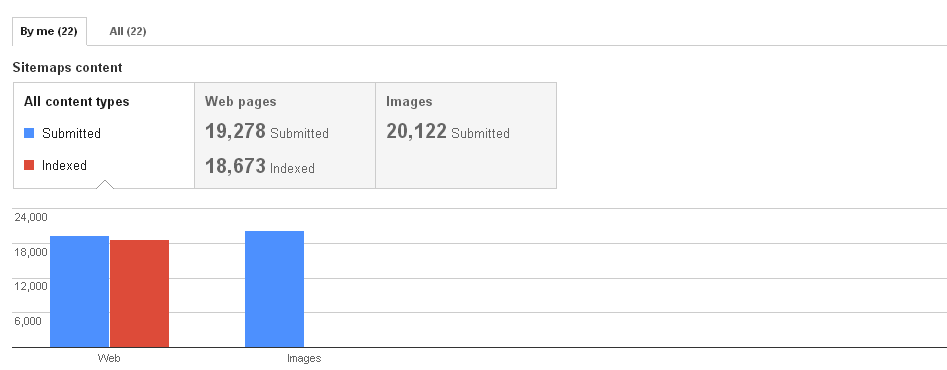 Can you please help me, why my images are not indexing in google yet? is there any issue? please give me suggestions?Thanks!
0
Can you please help me, why my images are not indexing in google yet? is there any issue? please give me suggestions?Thanks!
0 -

Questions about the Sandbox and 301 Redirects
Does the sandbox still exist? What if you have a brand new URL and do a 301 redirect from another website because the name of the service business changed? Thanks for any insight and help.
Technical SEO | | SDSLaw0 -

What to do with 302 redirects being indexed
Hi there, Our site's forums include permalinks that for some reason uses an intermediary URL that 302 redirects to the URL with the permalink anchor. For example: http://en.tradimo.com/learn/chart-analysis/time-frames/ In the comments, there is a permalink to the following URL; en.tradimo.com/co/50c450005f2b949e3200001b/ (there is no content here, and never has been). This URL 302 redirects to the following final URL: http://en.tradimo.com/learn/chart-analysis/time-frames/?offset=0&limit=20#50c450005f2b949e3200001b The problem is, Google is indexing the redirect URL (en.tradimo.com/co/50c450005f2b949e3200001b/) and showing duplicate content even though we are using the nofollow tag on these links. Ideally, we would directly use the last link rather than redirecting. Alternatively, I'd say a 301 redirect would be preferable. But if both aren't available, is there a way to get these pages out of the index? Is the canonical tag the best way? I really wish I could just add /co/ to the robots.txt file, but I think they would still be in the index, right? Thanks for your help!
Technical SEO | | etruvian0 -

• symbol in title tag
We have a few title tags with a circular dot symbol, which is created by the code "•" Humans see a dot, but googlebot sees • Does this negatively impact our SEO, or is googlebot aware that **• == *** to human eyes
Technical SEO | | lighttable0 -

Google is indexing my directories
I'm sure this has been asked before, but I was looking at all of Google's results for my site and I found dozens of results for directories such as: Index of /scouting/blog/wp-includes/js/swfupload/plugins Obviously I don't want those indexed. How do I prevent Google from indexing those? Also, it only seems to be doing it with Wordpress, not any of the directories on my main site. (We have a wordpress blog, which is only a portion of the site)
Technical SEO | | UnderRugSwept0 -

Very Quick Joomla Question
Hi, A client's site was previously built in Joomla and he wants us to reproduce content that was in there, but the Joomla site is no longer live and has come to me as an archive containing all the files and folders that were included. So, I am looking at the files and folders without Joomla installed. Can someone tell me quickly how to find the where the actual page content was stored? I started looking, but there are some folders I cannot open and nothing that looks as I expected. Would appreciate a hint or two from someone who knows Joomla well.. Life is too short! Thanks Sha
Technical SEO | | ShaMenz0
